The two sides of Luxor
From a tourist perspective, Luxor is divided by the Nile River into an Eastern and a Western Half. The Eastern Half is where the city center is located and where most people live. Life here is bustling and loud with famous sites like Karnak Temple and the Temple of Luxor drawing hundreds of thousands of visitors each year. If you want to connect to other cities in Egypt like Aswan, you will have to go through here, as both the bus terminal and the train station are located near Downtown. I wrote about more details about transportation in a dedicated post on connecting Luxor and Aswan.
The East Bank showcases the culture and life of everyday Egyptians but honestly, the city itself is not a pleasant place to stay, due to excessive noise, pollution and the chaos all day. It is nice to experience, but most visitors will tell you, that the Western Bank of the Nile is much calmer and is the real soul of the Nile Valley.
Here, the city fades into lush green fields fast and gives way to smaller villages, which line the quiet roads. World famous sites like the Valley of Kings and the Hatshepsut Temple top it all off, making the West Bank a tourist’s favorite overall. Most accomodations are also located here making it the perfect base from where to explore Luxor. If you are looking for a budget accomodation, I can really recommend Kareem Hotel, which we stayed at for 3 nights. We paid just 50€ in total. It has a perfect location in the city but with quiet and modern rooms to stay in.
Between the two sides of Luxor, no bridges exist within city limits but there are public ferries taking you across for 25 EGP (roughly 0,40€) a ride. You can also choose a private ferry to avoid waiting for the ship. These typically cost anything between 100 and 200 EGP depending on your negotiation skills.
Why cycling is the best option
The West Bank with it’s world famous attractions has one major drawback: distance. Most accommodations are located near the ferry terminal, making walking to each of the attractions in one day completely impossible due to the long ways in between. It is not like the East Bank where everything is condensed into one urban layout, but spread out between the edge of the desert and the bank of the Nile.
Your only option other than taking a bicycle would be to hire a private driver to take you from place to place or join a group tour, with both options having some major drawbacks. One the one hand, they cost more. Hiring a driver will cost you between 20-50€ for the day. Tour groups are more expensive as well, with our hostel charging roughly 12€ to shuttle all guests from place to place.
In addition to that you are on a fixed route with fixed schedules, so you cannot spend as much (or as little) time as you want at each spot or go for a detour. Walled off in a tourist bus or a car, you will miss the perfect opportunity to experience the spirit of the Nile River Valley for yourself and be in a crowd of other tourists all day.
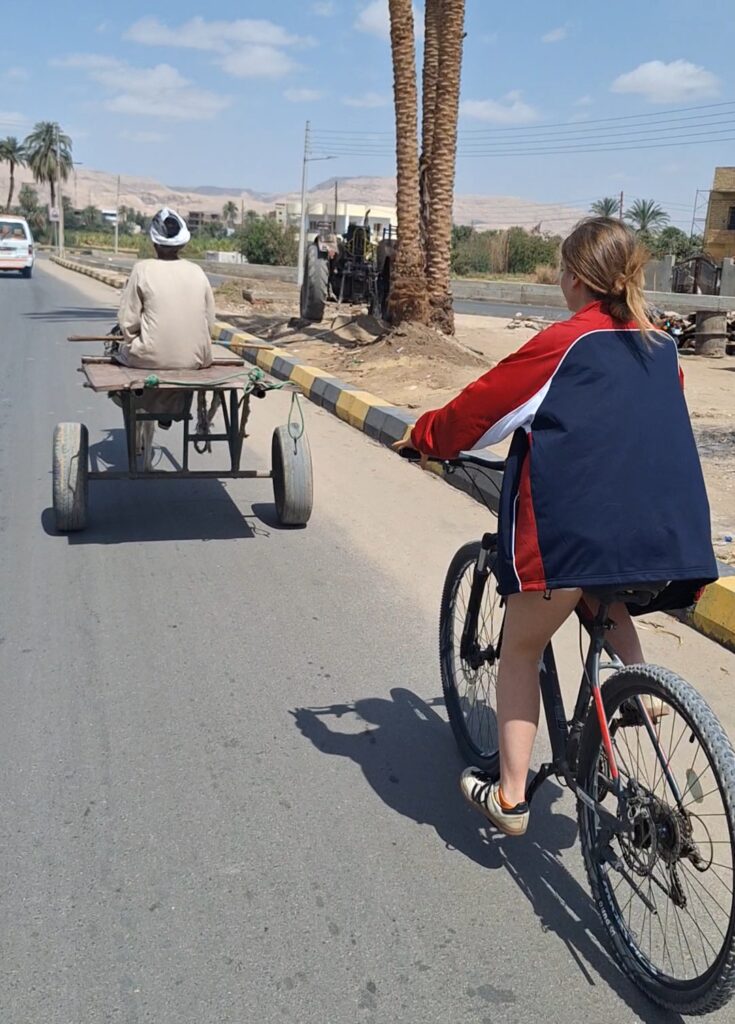
When cycling through the area, you can see workers on their fields, stop at small restaurants and cafés, take detours through smaller and quieter streets and enjoy each locations as much as you like. And if you wonder about the weather: Yes it can be hot but as the distances between places are not really that long or physically demanding, it is no real concern. You are outside anyways, when at the sites. Therefore I would strongly recommend going with this option when in Luxor.
Rental Shops
You basically have two options for renting a bike on the West Bank. One is Bicycle Rental Mohamed Setouhy and the other one is Hassan Bike Rental. Both are located on the main street near the ferry terminal and are easy to find. In our case we went with the first option but purely because it was closer to our accomodation. Both had bikes standing out front, which looked very similar.
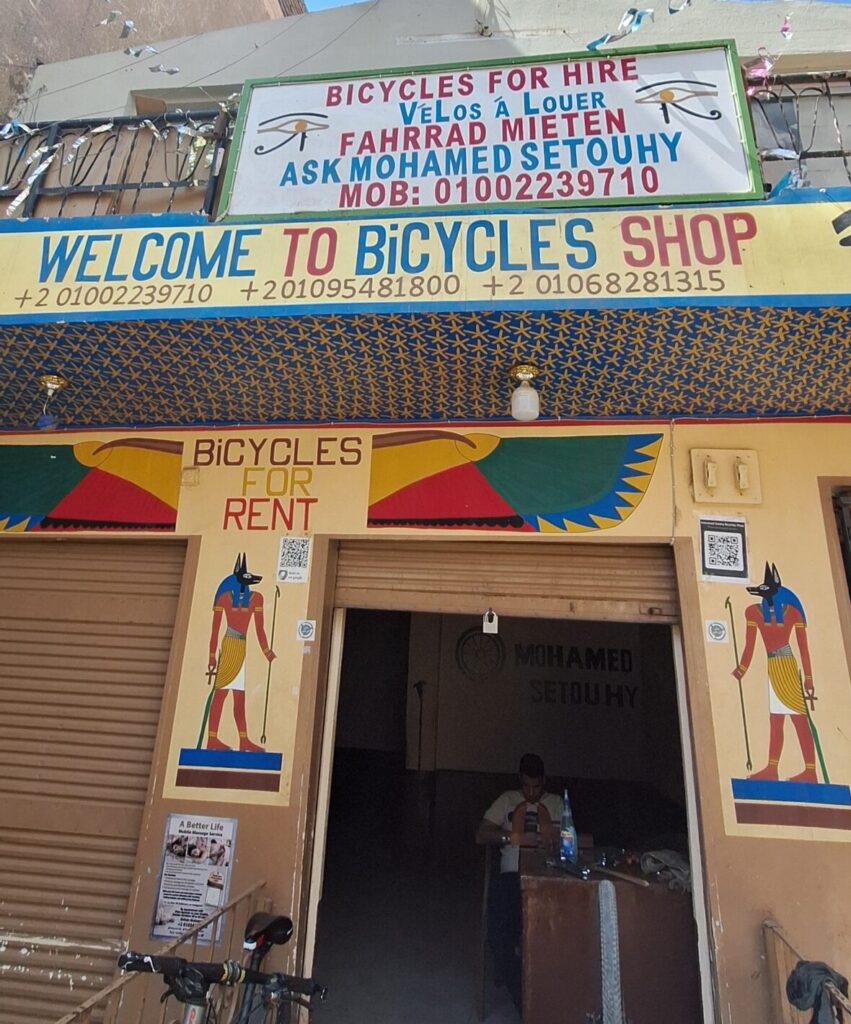
The quality of bikes differs a bit but you can choose one you like and test it out. In our case, we did a short ride along the main street and swapped one of the bikes for another one, because the shifting was a little stiff. The owner was very kind, checking the air and giving us a lock to secure them along the way.
We paid just 250 EGP for the entire day per bike. In my opinion for the quality you are getting, this is a steal. No deposit was required. We had no issues the entire day, but he made sure to give us his number. In case that the bikes malfunctioned someone will apparently bring a new bike.
Make sure to talk to the owner directly and not with some of the guys standing out front. It is possible that they do not even belong to the shop yet try to rent you a bike anyways in order to score a commission.
A day on the bike
Luxor to the Valley of Kings
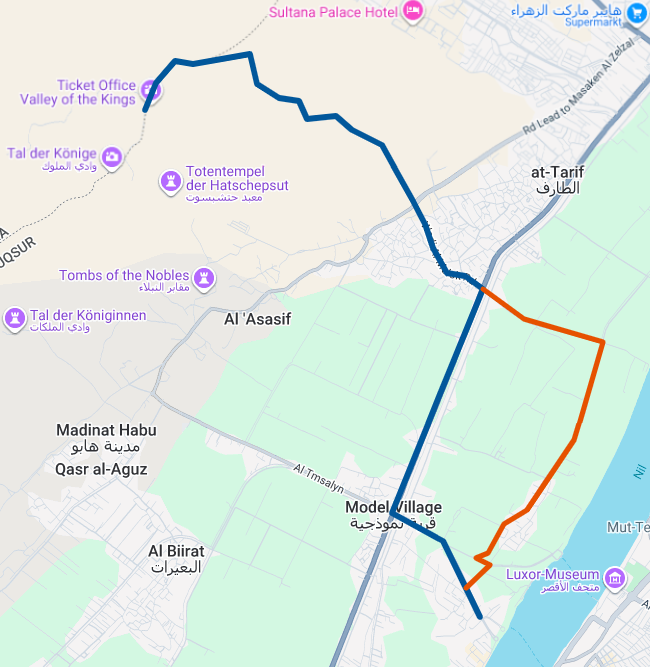
The first part of the journey is from Luxor to the main event: The Valley of Kings. Following the blue route you will join the main road leading towards At-Tarif before heading left into the mountains. But do not worry. Traffic is not as crazy as in the cities and biking is certainly enjoyable.
If you want to avoid cars completely and are okay with riding on dirt, then take the orange route (Al Quarna Road) through the fields and avoid the main road. The road here is not asphalted but perfect to ride on with mountain bikes.
On the road up to the entrance of the Valley of Kings, you will have to share the lane with cars and busses but it is quite safe as the road is very wide.
Tip: Coffee culture is imbedded into Egyptian society and if you want to have an authentic taste of local blends with flavors such as cardamom and nutmeg without landing in a tourist trap then come to بن وادي الملوك coffee shop. It is a small location on the road leading through At-Tarif. The owner was very friendly and even speaks a little English. He introduced us to the world of egyptian coffee specialties taking his time to explain the process in detail. Best coffee we had in Egypt and a perfect souvenir to take home. The shop is in a very local area and you will not see any other tourists here.
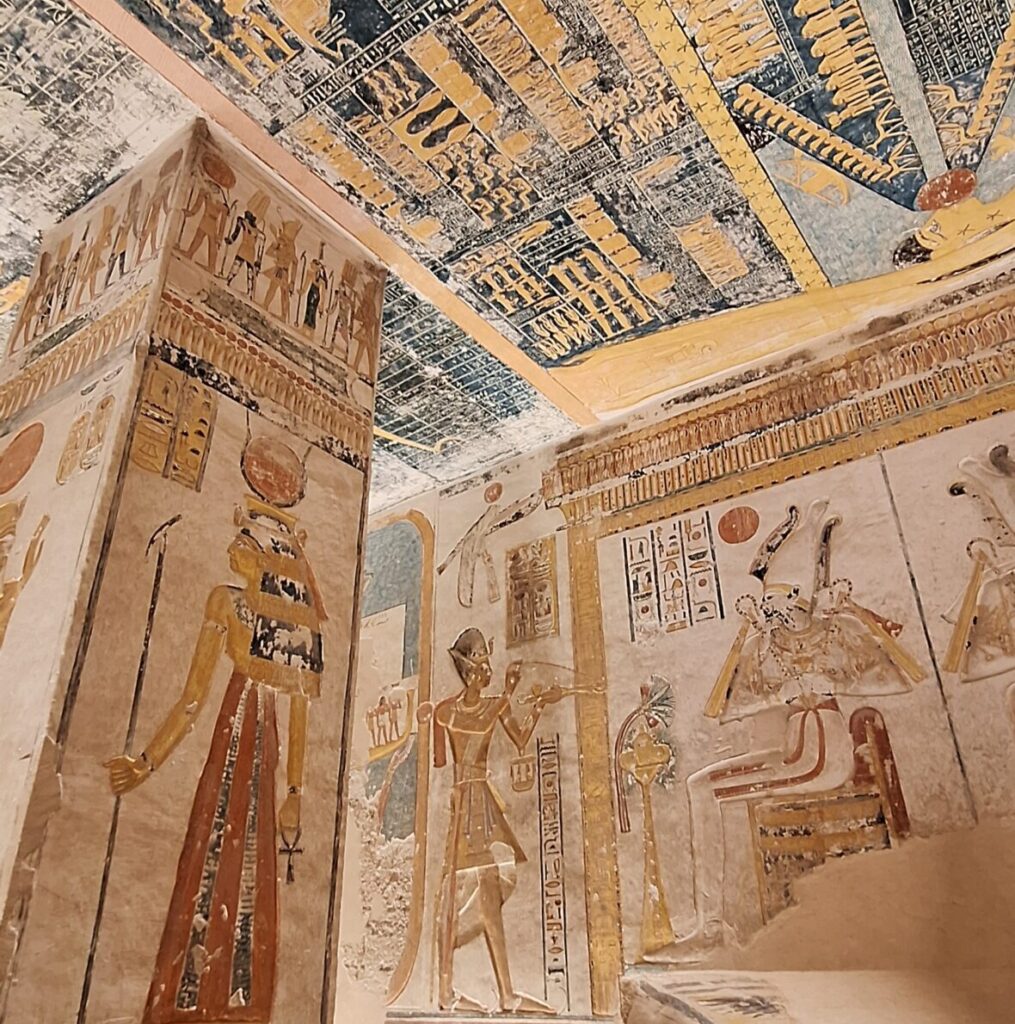
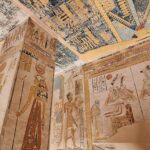
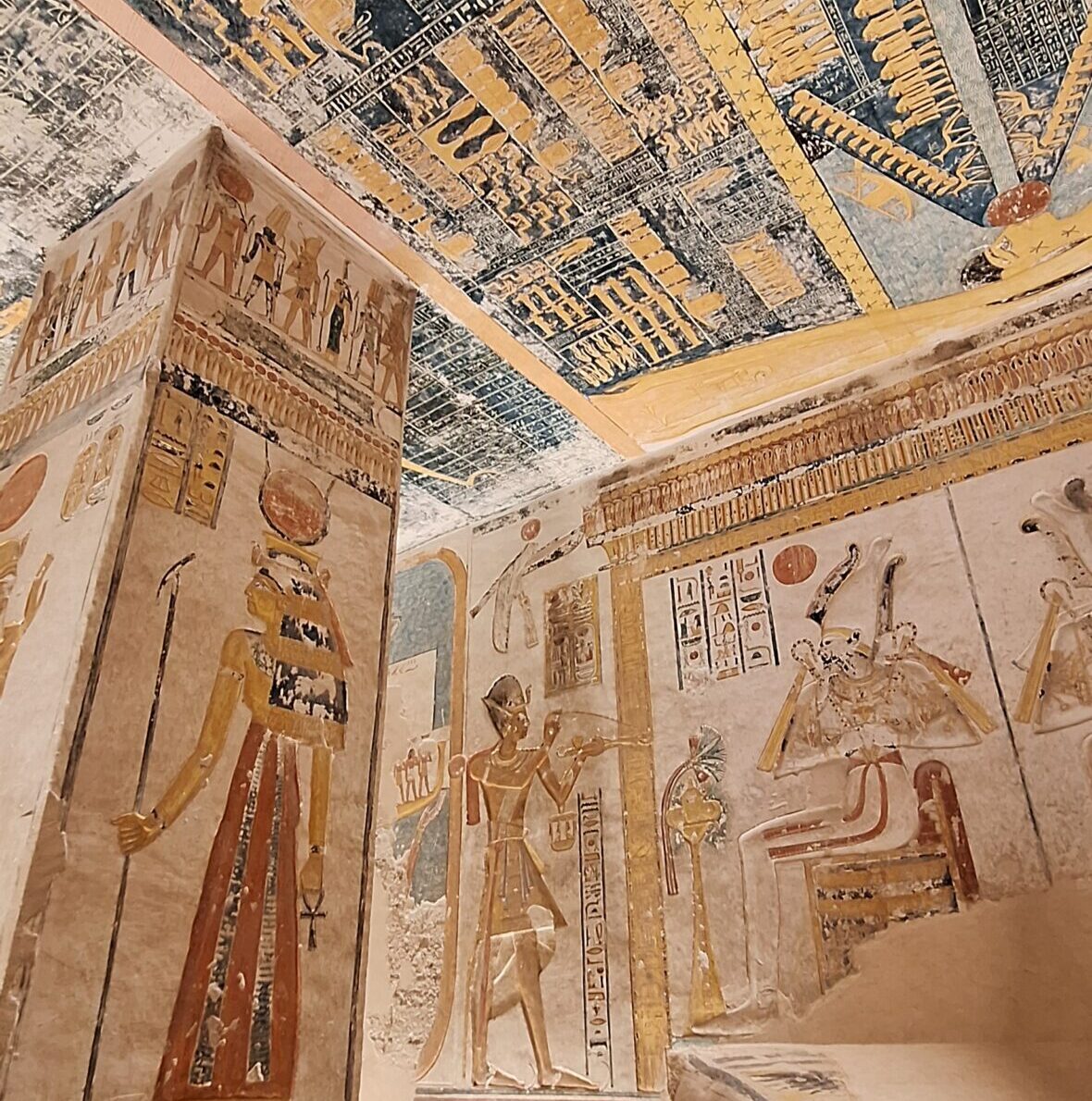
Upon reaching the Valley of Kings, secure the bikes near the mosque and head in. The site served as the burial place for pharaohs of the New Kingdom, including the legendary tomb of Tutankhamun. Today, visitors can explore its ancient rock-cut tombs and admire the fascinating hieroglyphs and artwork preserved inside.
Take your time here and explore everything you can. Not all tombs look the same, some are more detailed, while others look quite raw. One thing you do not need to do is to pay for the tomb of Tutankhamun. In my opinion it is not worth the extra 10€ as nowadays it is only a small, empty chamber. All of the priced artifacts can be found in the Egyptian Museum in Cairo with the tomb remaining bare.
Valley of Kings to the Temple of Hatshepsut
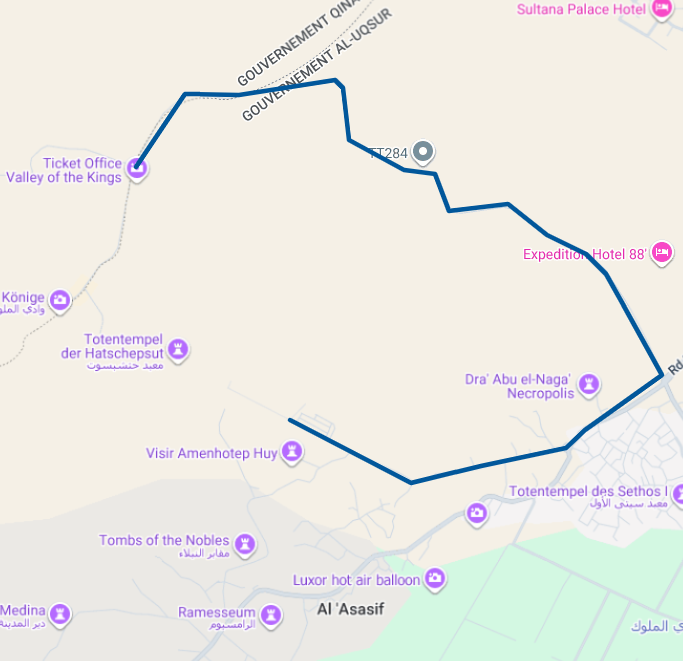
After returning from the Valley of Kings, take your bike and head down back towards the main road. Turn right and head towards the Temple of Hatshepsut. It is not hard to miss. Just follow the route all tourist busses take. The distance is roughly 5 kilometers. The entire route is asphalted.
When arriving at the entrance to the Hatshepsut Visitor Area you have the added advantage of being able to park your bike right next to the entrance, which saves you the long walkway along the souvenir stands. The Temple itself is still quite a walk away from the entrance. If you did not sweat before you definitely will here.
The Temple of Hatshepsut itself is a stunning ancient monument built for Queen Hatshepsut, one of Egypt’s most powerful female pharaohs. Carved into the cliffs of Deir el-Bahari, the temple is famous for its impressive terraces, elegant architecture, and beautiful reliefs. It offers a unique glimpse into the history, achievements, and legacy of one of Egypt’s most remarkable rulers. From here you also have an excellent view over the Nile River Valley. Keep in mind, that during midday, it can get really crowded with all the day trips from Hurghada reaching the West Bank by Noon. Start early to avoid the huge crowds coming here each day.
Temple of Hatshepsut to the Medinet Habu
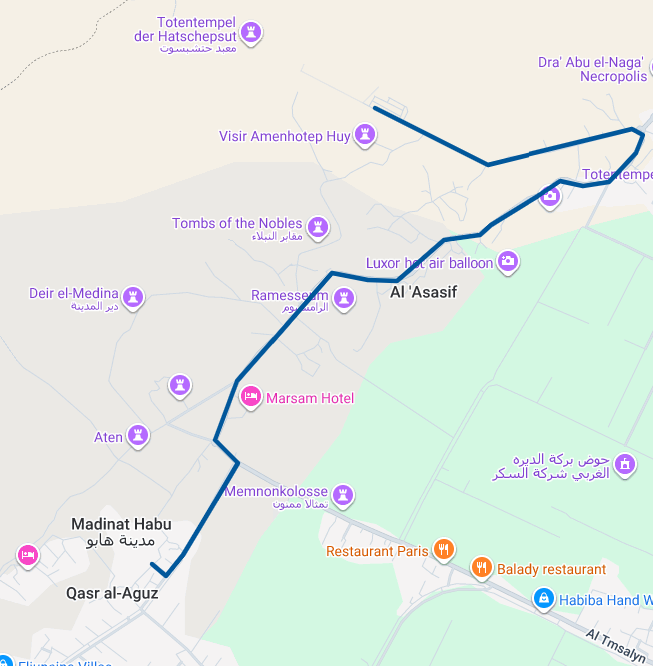
Cycling from the Temple of Hatshepsut to Medinet Habu does not take long as it is only a short 4,5 kilometer ride and mostly downhill. Ride by the „Ramesseum“ the large Mortuary Temple of Ramses II.
Not having joined a tour group, you can also avoid all of the Alabaster shops where all other busses stop (the drivers get commissions on sales). In my opinion, these kinds of stores are only there to scam unaware tourists.
Looking to the right along the way, you will get an idea of just how many graves there actually are. The sites visited on this route are just the tip of the iceberg with hundreds, if not thousands of grave sites dug into the mountains above. Most of them are unexcavated or have decayed almost entirely through the years.
Medinet Habu for us was the highlight of the day. It is huge and I would even go as far as to say it is the best temple in all of Egypt, even rivaling Abu Simbel. The tourist busses from the other sites in Luxor do not reach here, making it much quieter and calmer. It reminded me of the temples in Siwa, another overlooked destination in the country. In case you are hungry, there are some restaurants out front to enjoy a snack.
The Temple is one of the best-preserved ancient temples on Luxor’s West Bank, built by Pharaoh Ramesses III during the New Kingdom. The massive complex is known for its impressive gateways, detailed reliefs, and colorful wall carvings depicting battles, rituals, and scenes from ancient Egyptian life. Arrive late to enjoy the special lighting created by the low sun and the towering stone columns. It was the perfect way to finish to this day trip.
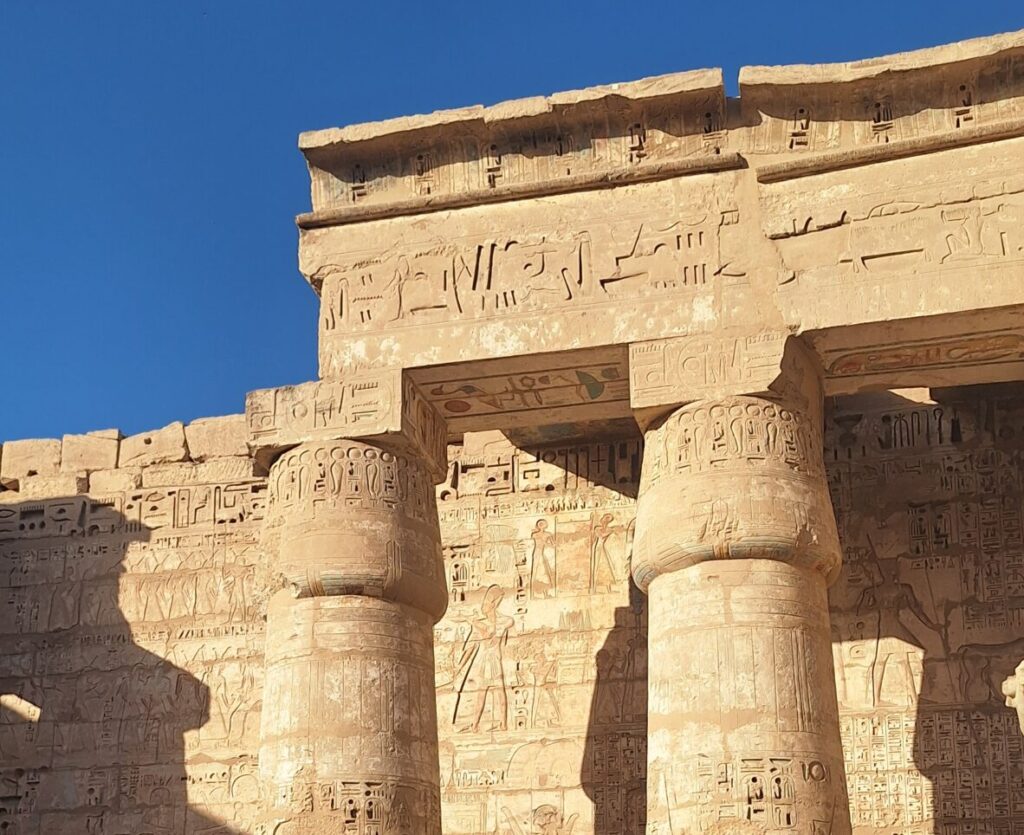
From Medinet Habu back to Luxor
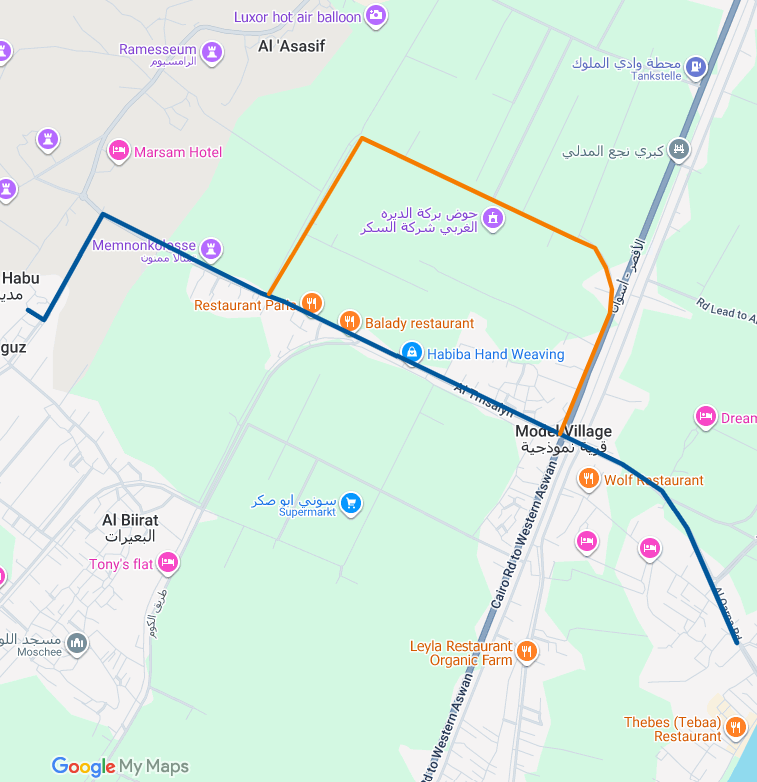
We left Medinet Habu at closing time around 5pm back towards Luxor. Pass the Colossi of Memnon on the way. They are free and offer good photo opportunities. The direct route (blue) is 4,1 kilometers, but if you have some time to spare and want to get the dreamiest photos of the lush green Nile Valley fields then take the detour (orange). It is unasphalted but takes you along canals through the rice and vegetable plantations. We passed a couple of farmers on their tractors along the way, which brought in their harvests. With the sun already standing low above the horizon, the atmosphere is perfect for photos or even just to relax from the long day.