A Hidden Gem for Cyclists
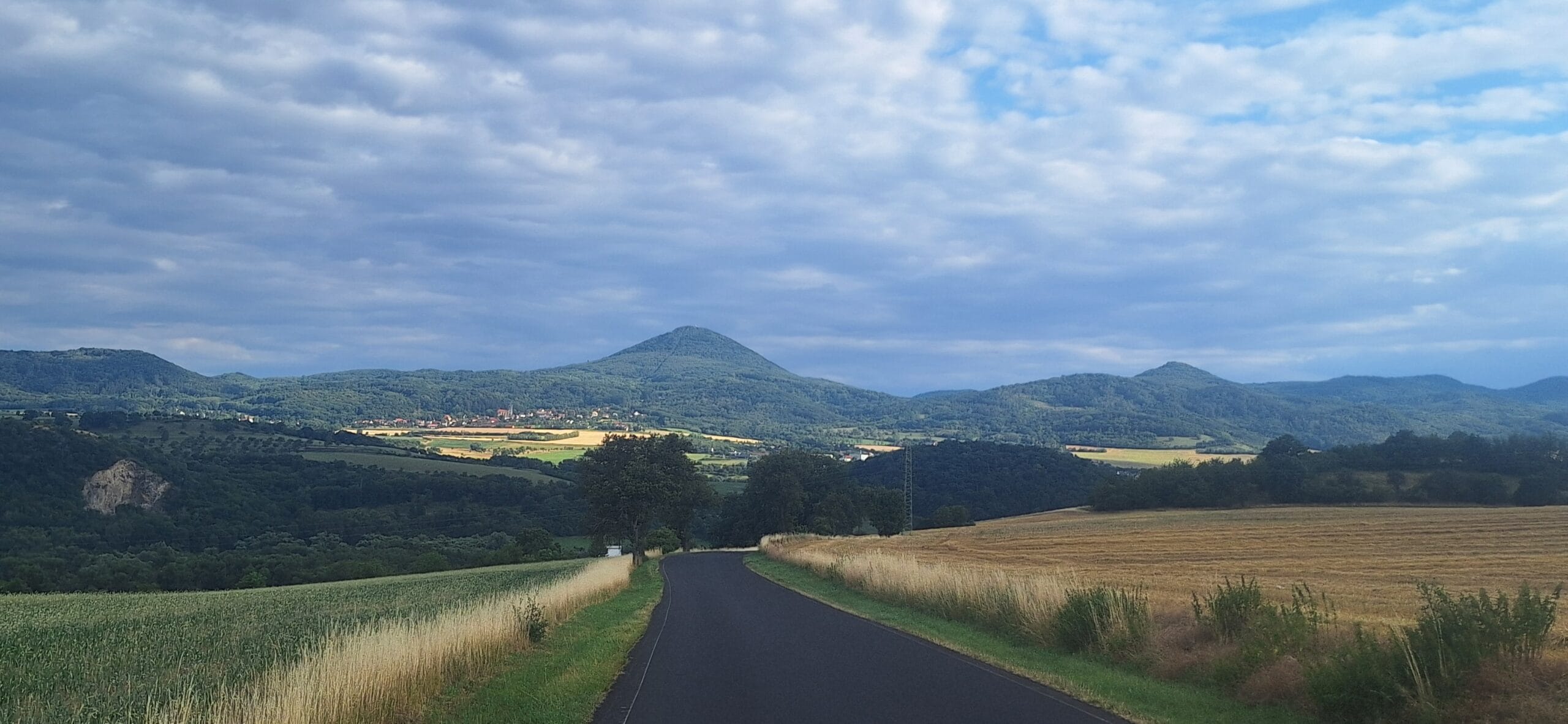
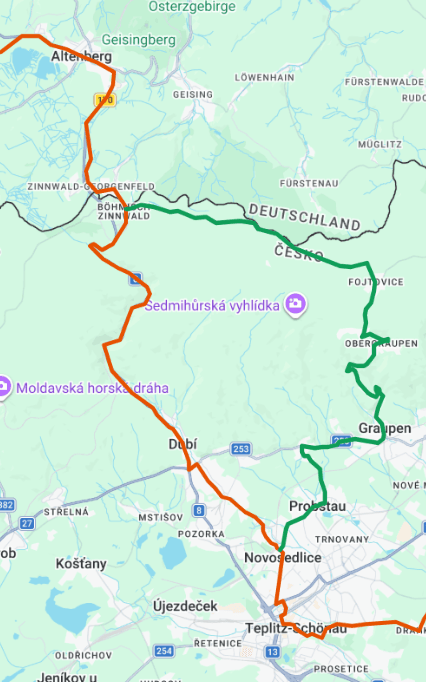
This 2 day, 1 night Bikepacking trip is perfect for a weekend escape. Starting from Dresden, head south into the Ore Mountains. Climb over its pass roads and descend into Northern Bohemia to discover the beauty of Northern Czechia. The final destination of this trip is the „Milešovka„, the highest mountain of the Bohemian Highlands (České středohoří). It offers a 360 degree view of the surrounding landscape and rewards you for the tiring journey.
Not many people will choose this route because it is unknown and not the easiest. You must be physically fit, given the steep ups and downs, the complete opposite from my prior bikepacking trip across Eastern Germany. In turn, you will enjoy breathtaking landscapes and small picturesque villages along empty mountain roads. A stark contrast to the often overcrowded Elbe Cycle Route nearby. I encountered very few people taking on these streets, especially in the hillier sections. Whilst on the German side, I saw other riders from time to time, much fewer cyclists were around in the Czech Part, especially in the Bohemian highlands, where I saw no other bike the entire time I was there.
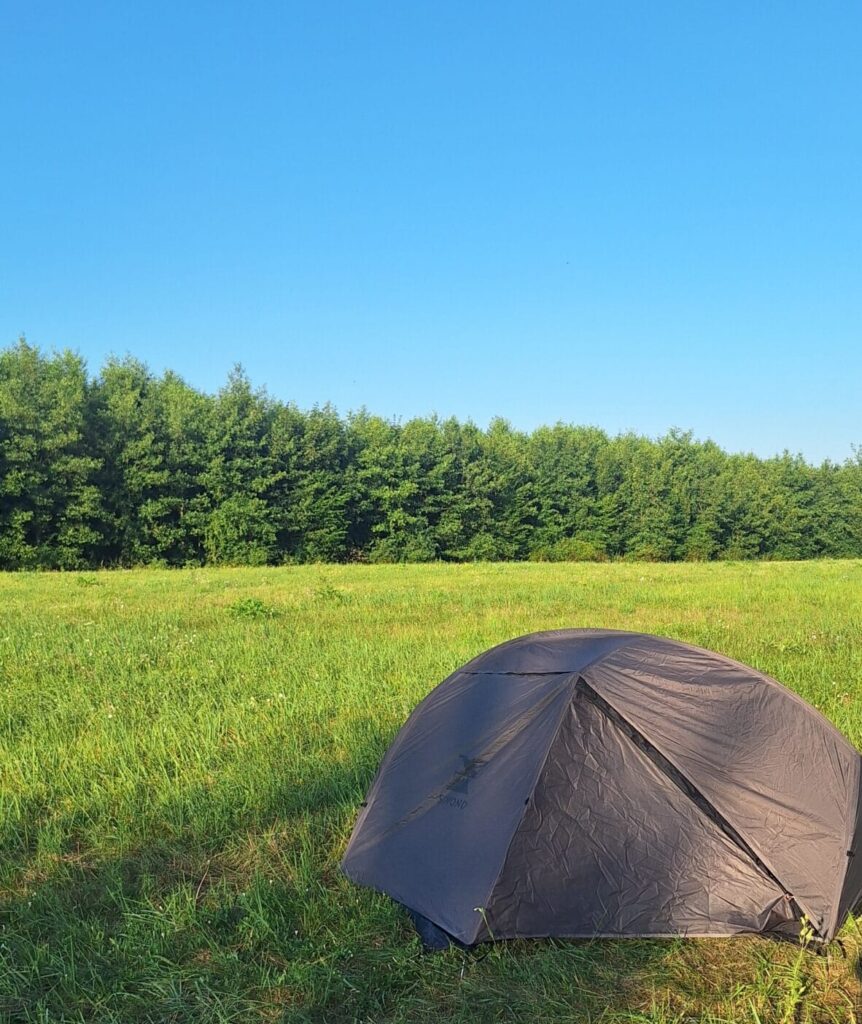
During my night in the Czech Republic, I was also able to find a free and legal camp spot, which I can highly recommend. For more details, read down below.
Steep Climbs and Breathtaking Views
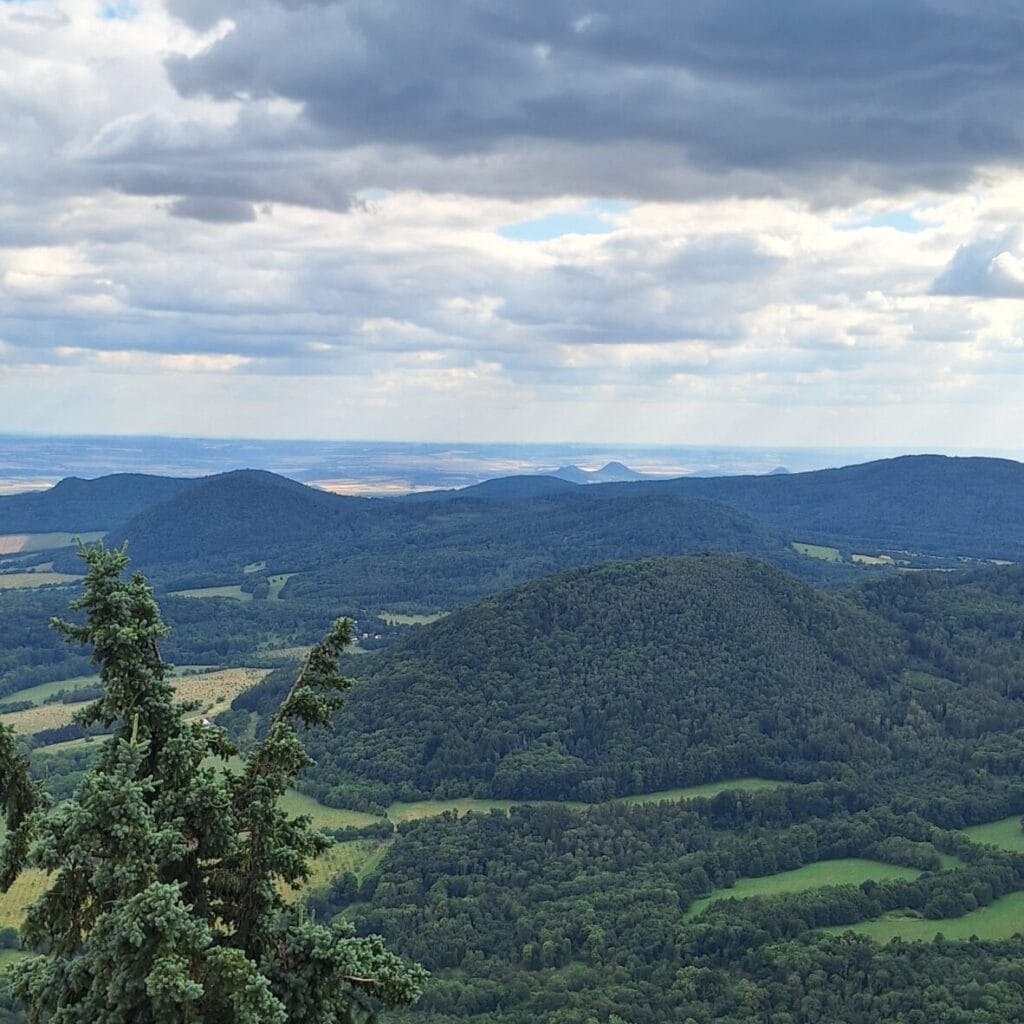
Bikepacking across two mountain ranges, even if they are much lower than the Alps for example, is very strenuous indeed. You will have to face steep climbs and on some sections, you might even want to push the bike instead. In turn you will be rewarded with stunning views over Saxony and Northern Bohemia.
The character of this itinerary is not for the weak, as you will almost constantly be climbing or descending. Still, almost the entire distance leads you across asphalted roads, which makes it a bit easier. Only near Milešovka will you come in contact with gravel and some rocky trails. This is also the hardest part in my opinion, as the ascent to the top gets progressively steeper. I had to push my bike the last 200-300 meters up, but I guess this depends on your trail riding experience.
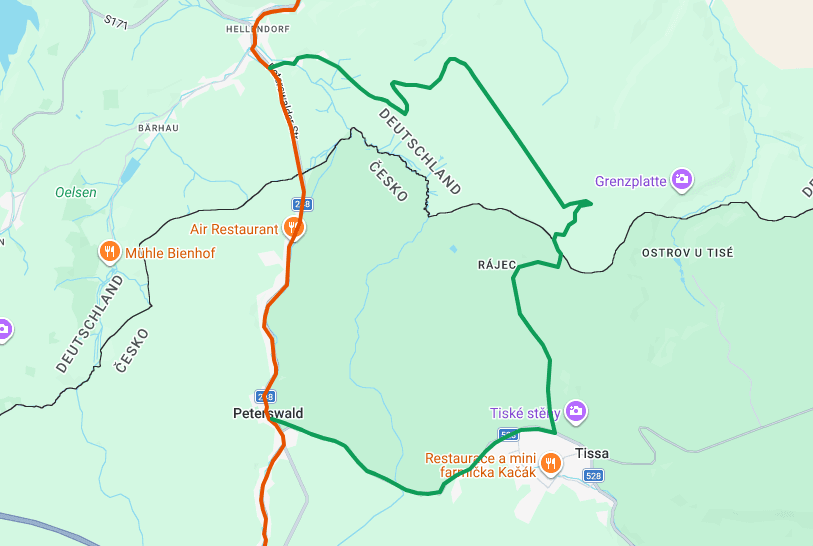
Most roads shown in this itinerary are low traffic except some stretches along the passes of the Ore Mountains, where many people transit across the border. In this case I provided some alternative routes, that are much quieter, which you can take instead.
Along the route, you will find plenty of opportunities to resupply as it passes by multiple smaller and bigger towns and villages, where supermarkets and restaurants can be found. In Czechia especially, even the smaller villages almost always have a small restaurant/bar, so it is never far to your next Svíčková s knedlíkem 😉
Route Overview
Itinerary
From Dresden to the border
Start in the Old Town of Dresden at Neumarkt and head along the stunning Elbe Cycle Route until Pirna to avoid the traffic of the city. Here you will branch off from the Elbe and head along the Gottleuba River starting the ascent into the Ore Mountains. After leaving Pirna, the road will soon become much quieter, winding through the wooded valley road. After Rottwerndorf and Neundorf, stop for a second at the Langhennersdorf waterfall, which can be found right next to the street reachable through a narrow crack in the rocky wall. Definitely not the kind of thing, I expected on a Bikepacking Trip.
Head onward up the valley and turn left at the intersection to Bahra. This even quieter road now really allows you to gain elevation and leads you up through typical saxon mountain villages towards Helendorf. Here you join up with the main road in order to cross the border. It is a bit more busy, but it is the only asphalted road in the area that leads you into Czechia. If you want to avoid this stretch, you can take a left in Helendorf towards Rájec via the Zeisigstein Mountain indicated on the signs in the village. From here, you can reach Petrovice via Tisá. This detour is not asphalted on the German side, leading along mostly flat forest roads instead.
Steep drop into Ustí
The first village after the border is Petrovice. Here you can find something really unexpected: The „Air Restaurant„, a theme restaurant, which is located fully inside a Tu-104 jet aircraft. You can enjoy some authentic, good Czech food here for lunch before continuing onward. The aircraft was build in the 1950’s in the Soviet Union and later sold to the Czechoslovaks. It was in use until 1993, when it was transported to the village. The restaurant inside it opened two years later and is running to this day. Truly a hidden secret in the Ore Mountains, as I myself living just 40 kilometers away had never heard of it before.
After Petrovice, follow the main road toward Nakléřov and begin the long descent down the Ore Mountains into the Ústí Basin. The descent is considerable, with 561 meters separating the pass from the basin’s lowest point in Ústí nad Labem. Sadly, nowadays Ustí is run down and many parts of the city feel neglected and kind of empty. The city had it’s heyday during the time, where coal mining and heavy industry flourished, but after these plants closed in the 1990’s, the city started crumbling with them.
Up the Bohemian Highlands
Head on through Trmice and turn left towards the steep incline into Hostovice, the beginning of the Bohemian Highlands. Although not as high as the Ore Mountains, they are in my opinion much steeper as their prominence is a lot greater considering to the low-lying areas surrounding them. You will probably be the only one crazy enough to ride a bike here. But apart from the altitude, the roads are asphalted and in great condition all the way to the base of the Milešovka Mountain with very little traffic at all, all the while offering beautiful views of the Ore Mountains on one side and the flat Bohemian Basin on the other side.
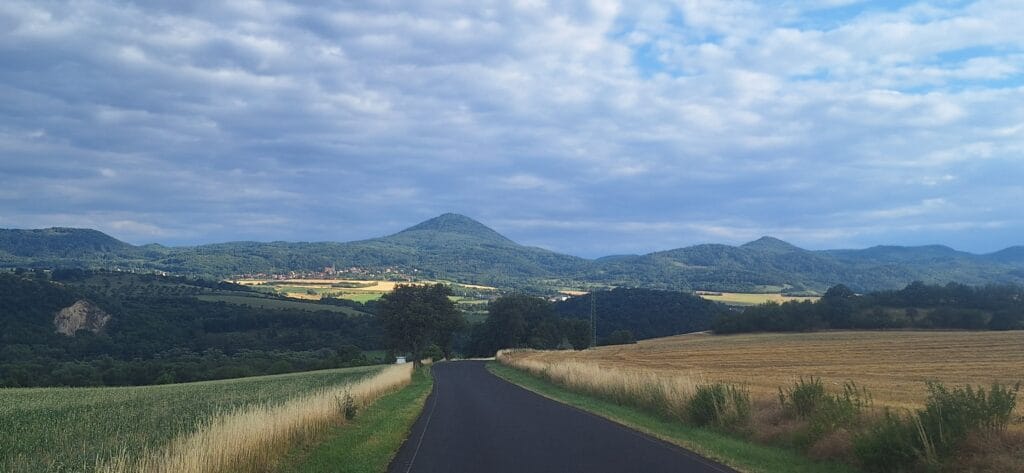
Milešovka is the highest mountain in the range and like all the other peaks of the area, it is of volcanic origin. This is clearly visible in it’s cone shape visible from a far. When reaching the base of the mountain you will also encounter different geological features compared to the surrounding lands, as the ground is littered with tons of flat basalt sheets scattered loosely on the ground. A fascinating geological phenomenon and a stark contrast to the flat „mountains“ in the Ore Mountain Range.
Climbing Milešovka
When approaching the mountain, ride around it to it’s south side to avoid the steepest trails. Turn right onto the trail leading to the top. It is indicated clearly and is much rockier than the forest road. If you do not have a mountain bike with a lot of grip you can leave it here at the base and hike up the remaining kilometer as well. There is a wooden shelter you can secure it to.
The trail itself is fairly wide with a couple of switchbacks, getting progressively steeper the nearer you get to the top. I quite enjoyed the climb, although I had to get of the bike a couple of times when bigger rocks lay on the path. To be clear, the path is not dedicated to bikes and you will probably be the only one here, but it is definitely doable. Avoid the northern approach to the top, as this trail is far too steep for bikes, although it looks shorter on the map.
Enjoying the scenery
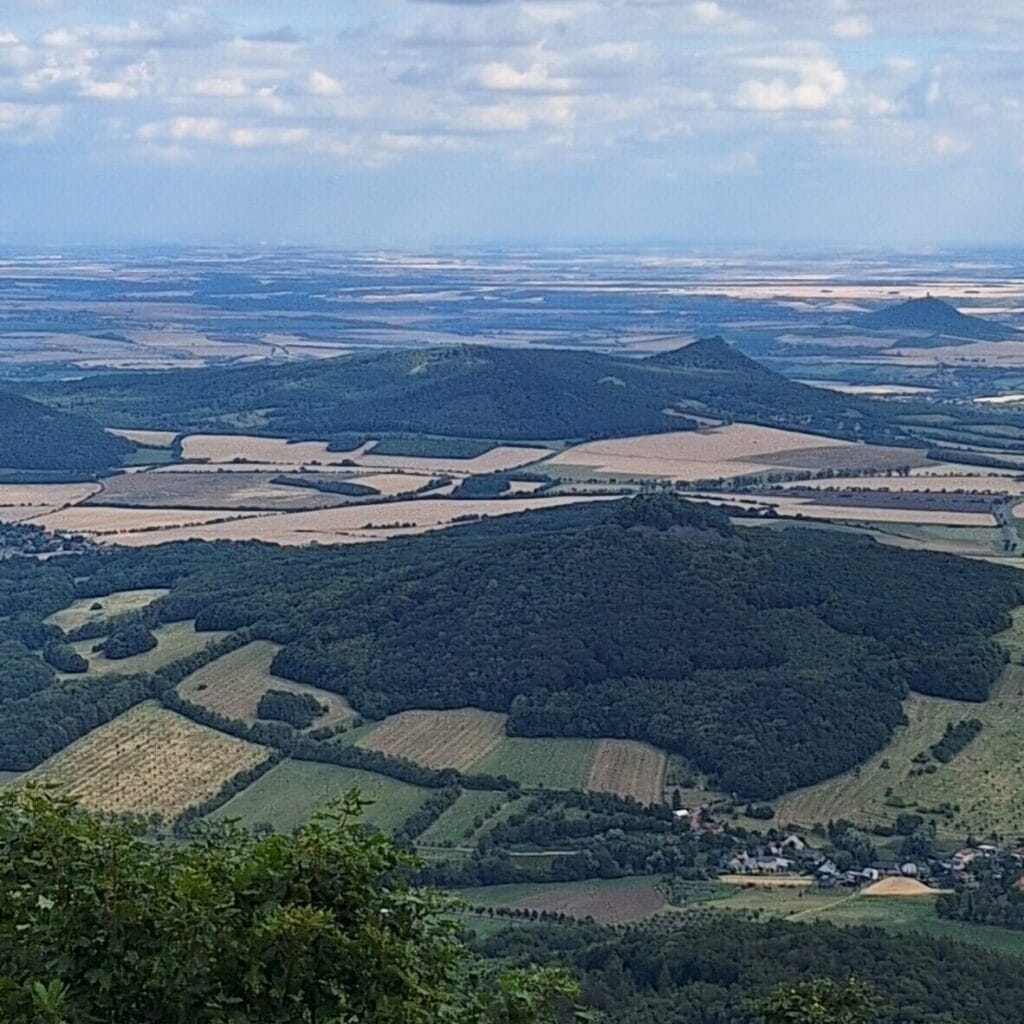
At the top there is a small hut offering drinks and snacks with a panorama window, although prices are quite steep and no card payment is possible. In the center of the peak though is the meteorological station called „Donnersbergwarte“ in the style of a small castle built in 1905, which is the highlight of the peak. It is possible to enter it, as there is a viewing platform with 360° views on the top as well as a small museum. Entry costs 50 Kč. On the one side you can see the entire length of the Ore Mountains, and on the other you can see Prague and even Ještěd in the distance. Truly this must be the best viewpoint anywhere in Czechia as I did not even get such a view on the top of Sněžka, Czechia’s tallest mountain.
Descent towards Lake Milada
After spending roughly 1 hour at the top it was finally time to get back down. By this time it was 5 pm already and I was getting quite hungry. The hut at the top only offers snacks, so I had to start my descent, At the second switchback I turned right and headed along the western flank of the mountain into the valley to the North. Ride your way through the villages of Bílka, Bořislav, Žalany and Rtyně nad Bílinou to the Milada Lake.
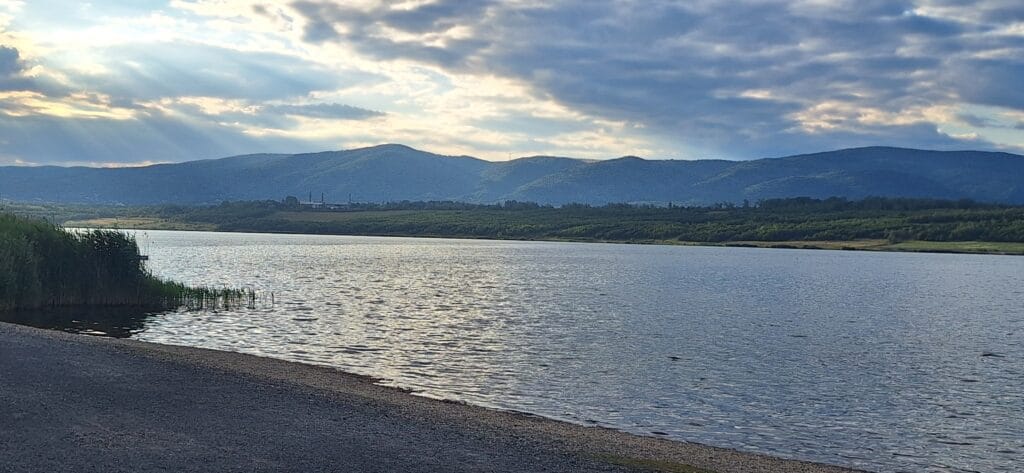
Here, there are two legal camp sites, where you can pitch your tent for free (although you have to be self-sufficient). I would recommend you to stay at the spot on the southern shore near the village of Roudníky. Even though you are not right by the lake it is much quieter and more secluded than the other campsite, which sits not far from a busy highway and has no trees or anything for cover. Furthermore, on the eastern side there are more people on the beach during daytime and in the evenings as this side is close to Ustí and a popular beach destination.
Steep climb to Zinnwald
I started of the second day of the trip with a refreshing swim in the clear water. As temperatures were set to rise above 30°C on this day again, this was perfect to cool off before a heated ride back to Dresden.
From the Milada Lake head west towards Teplice through the villages of Roudníky, Modlany, start Srbice and Drahkov. Do not choose the main road to get into Teplice, as the traffic there gets crazy on weekdays. In the city center you can buy breakfast at one of the beautiful cafes or bakeries of which there are a quite lot for such a small town. There are also several supermarkets to stock up your supplies for the climb ahead.
From the market square, which sits at 217 meters above sea level, you will now have to climb to the top of the Ore Mountains via the Pass at Zinnwald, which is located at 864 meters. This 14 kilometer long climb took me roughly 1,5 hours to complete, but will compensate you with some epic views back down into the Bohemian Basin from the top. And once you reach the top, the hardest part of today’s ride will already be done.
The direct route, which I took, is using the main road, which also carries a lot of cars and trucks. If you do not mind a detour, I can highly recommend taking the road up towards the ridge line through Krupka a bit further to the east instead. The road is not as perfect, but there is far less traffic and the views are in my opinion better. The only downside: It is even steeper.
Altenberg Town
Once you have reached Zinnwald, head over to Altenberg, a famous winter destination in the Ore Mountains. There are ski lifts and cross-country skiing facilities during winter time, as well as a bob sled track, which holds a world cup race each season. In summer, the town is quieter and not too many people were there when I visited. Take a break near the ski lift and enjoy your well earned lunch. Temperatures hovered at around 23°C when I was there, while down in the valley, it was well above 30°C already, making it much more bearable in the summer time.
Downhill towards Dippoldiswalde
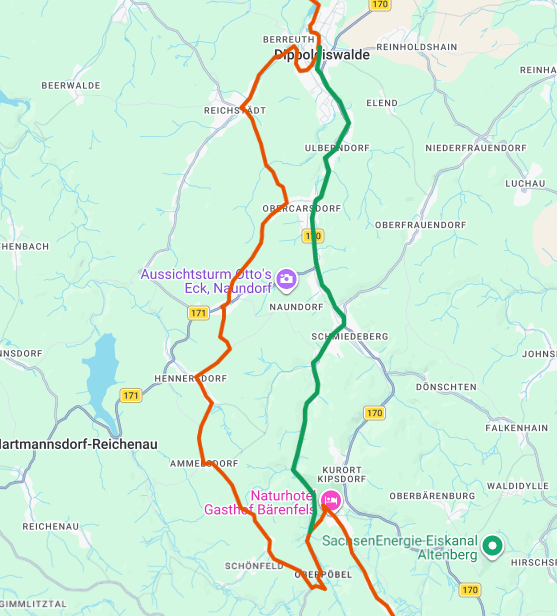
Now, the hard-earned downhill section finally begins. You can head directly to Dippoldiswalde through Schellerhau, Bärenfels and Schmiedeberg but if you have the time and stamina, a better route would be to follow the indicators for the cycling path towards the town. This adjacent, yet slower and hillier route leads you through the small and beautiful villages of Ammelsdorf, Hennersdorf, Sadisdorf and Reichstädt, before joining the main road towards Dippoldiswalde. There are almost no cars here compared the main road in the valley down below and the views towards the Ore Mountains Ridge and the Saxon countryside to the north are jaw-dropping. It does take comparatively long with over 40 minutes added to your ride in contrast to the valley road though.
Returning to Dresden
From Dippoldiswalde you have two options. Either you head alongside Lake Malter (good for swimming in the summer) and ride towards Freital through Borlas and Somsdorf before joining the main road into Dresden or you try to avoid the city for as long as possible by turning right in Seifersdorf, riding through Oelsa, Possendorf and Kleinnaundorf, before reaching the suburb of Kaitz on the southern end of Dresden.
Although the second day is a bit shorter than the first day, riding up and down the sometimes steep valleys with no real flat stretches for the entire journey makes it feel much more tiring. All in all the ride from Dresden to Milešovka and back was perfect for me to get to know my local area from a different perspective. While other cyclists stayed in the Elbe Valley (which is beautiful if you haven’t seen it by the way), I rode through charming small villages deep in the quiet mountains with views usually reserved for the mountain peaks of the Alps and other high mountain ranges. I will definitely try to do more of those itineraries in the future and hopefully you will soon read about them on this blog.